Motor communication
Periodic transmission
We start a periodic communication with each motor card on the SPI bus. Access to the SPI bus is mutex-protected and is automatically handled by the EventQueue. The mutex is important because electronically, all motors are connected to the same SPI bus.
Structure of the packet transmitted on the wire is composed of a Protobuf message, prefixed by a packet length and suffixed by a 32-bit CRC.
The messages passed are MainboardToBrushless and BrushlessToMainboard, stored in brushless.proto inside the sensor-data-protocol repository, alongside a 32-bit CRC value next to the packet.
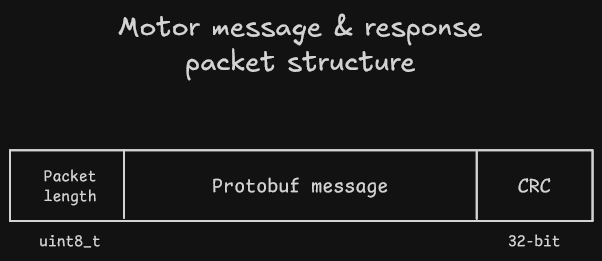
There are error counts available for display which represent the number of times the CRC check failed, either when the motor card receives a message (TX error), or when the robot receives the reply (RX error).
SPI Watchdog
A watchdog is in place inside the motor code, such that if the motor does not receive any SPI message after a fixed amount of time, the motor reboots entirely. This stems from the fact that F1 chips on the motor cards had a bug that blocked the SPI bus (or at least that was what I was told), so this measure has been put in place.
This watchdog is a very good way of determining if the robot firmware crashed. When that happens, all motors will reboot continuously while a green led is blinking ontop of each motor card.
Orders sent
The motors are speed-controlled and obey to the commands they’re told to perform by the robot card.
Once we receive a speed order from the decision software, through the base station, we transform this robot-frame speed order into 4 separate target speeds to transmit to each motor. This is performed in the compute_motor_speed() function.
The mathematics are based on formulas that were tailored for our robot, which is uneven because two wheels are at a 30 degree angle, and the other two wheels at a 45 degree angle. You can search up one of the TDPs of NAMeC that should explain these formulas more in detail.
On their side, the code of the motors have their own PID to ensure the ordered target speed is respected. Tuning of the PID coefficients has been performed some years ago, but never tuned again.